Pages

Saturday, October 3, 2015

Composition #1--Pizzicato Open Strings

Composition Packet--pizzicato open strings

Composition is an important component of my students' experience in orchestra.  From the very beginning of the school year, students are composing music that they can play on their instruments and that their classmates can play too.  I use composition as a way for students to dive into music literacy and to reinforce what they are learning about reading music.  It is an opportunity for students to be creative and actually create music to play instead of just read what others have written.  They start identifying as composers as well as string players.  It's very gratifying to see how different all the compositions are from each other within the limitations I've placed for them (open strings, pizzicato, four measures, quarter notes/rests).  I do type up everyone's compositions and turn them into packets so students can see what their classmates have created, see their own piece in print (they are published composers by the end of September!), and have lots of pieces to practice at home.  We also feature a few student compositions at our winter concert.  In their end-of-the-year orchestra surveys, there are always students who write that what they are most proud of with their work in orchestra that year are their compositions.

My example composition plus check-list


Composition #1 (open strings, pizzicato):

Template for composition packet:

Supplements: Extra Music for Orchestra Expressions Method Book


Orchestra Expressions supplement sample


I really like the Orchestra Expressions method book for beginning orchestra.  It was designed with the National Standards for the Arts in Music in mind, includes music from many different parts of the world, includes pictures of children demonstrating proper playing position, begins with the fourth finger and works down to promote good LH position, and connects to other disciplines and history through timelines and art connections.  It encourages improvisation, conducting, listening, movement, composition, as well as proper technique from the start.  I especially like the authentic, varied recordings on the CD that accompany each piece in the book.  They are performed on real instruments, and there are so many different genres of music represented on the recordings.  I could go on and on about why I chose to use this method book with my beginning students.

But, as with any method book, there are a few weaknesses.  Instead of introducing all four open strings at once, the book begins with just the three that all the string instruments share (A, D, G) and leaves E and C until much later in the book.  The 3/4 time signature also isn't introduced until much later in the book.

To address these issues, I wrote a short supplement packet that corresponds to the beginning of the book but includes the C/E strings and the 3/4 time signature.  I also added some harmony parts to familiar tunes that students can sing along to while they're playing.  Feel free to use with your students!

Orchestra Expressions Supplement:
Contents:
  1. Rollin' on D and A
  2. Plucking Open E/C
  3. Waltzing Up High/Down Low
  4. Shake 'em Up
  5. Mary Lee (Harmony)
  6. Au Claire de la Lune (Harmony)
  7. Ode to Joy (Harmony)
  8. Bile 'em Cabbage Down (Harmony)
  9. Pumping Iron #3
  10. E/C String Level
  11. Sidestep Shuffle
  12. Crossword Puzzle
  13. Crisscross
  14. Twinkle, Twinkle Little Star (Harmony)
  15. Jingle Bells (Harmony)

Once students have learned their D string notes, I give them a packet of familiar melodies they are ready to play, including a few with B on the A string.  Students enjoy playing these familiar tunes, and they are a bit more rhythmically varied than their books at this point.

D String Notes Supplement:
Contents:
  1. Hot Cross Buns
  2. Go Tell Aunt Rhody
  3. Barcarolle
  4. All Through the Night
  5. The Huron Carol
  6. Dreidel Dreidel
  7. Jingle Bells
  8. Twinkle Twinkle
  9. Old MacDonald
  10. Lavender's Blue
  11. This Old Man
  12. London Bridge

Enjoy!

**See this link for the post about the audio files to accompany the Orchestra Expressions Supplement!

Orchestra Expressions supplement example

D String Supplement Packet example beginning orchestra

Monday, September 21, 2015

Musical Timeline Wall

Music history timeline of composers

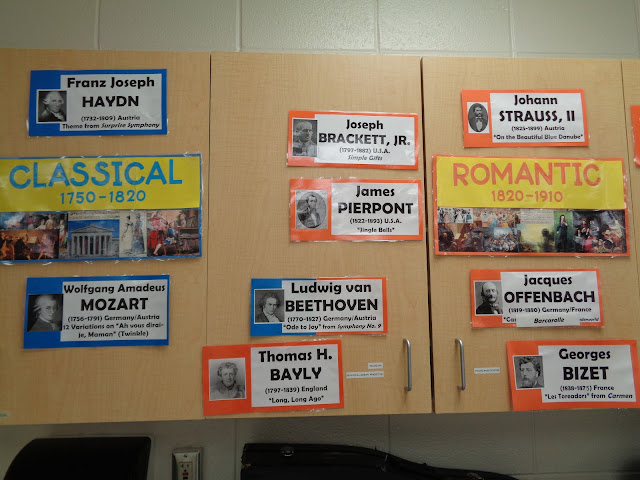
My classroom has a music timeline wall with the different musical time periods.  Composers of music that students are studying get added to the appropriate timeline so students have a visual of each composer and his or her place in history.  Each time period has a little collage of the architecture, art, fashion, and music of the time.  Composers studied in 5th grade are on top; 6th grade is on the bottom.  Each time period is color-coded, and each composer poster includes a pictures, dates, country, and title of piece the students are playing.  By the end of the year the cupboards are pretty full!  

I have more wall space at my other school, so here is the PDF of the larger composer posters and a Word document to add your own composers (scroll down to the bottom to see an example of the finished product).  If you're tight on space, here's a much smaller version with just composers from the Orchestra Expressions method book, book one.


Music history timeline of composers


Music history timeline of composers


Music history timeline of composers


Music history timeline of composers


Music history timeline of composers


Music history timeline of composers


Music history timeline of composers


Music history timeline of composers


Music history timeline of composers


Music history timeline of composers


Music history timeline of composers


Sunday, September 13, 2015

Flashcards

Music flashcards violin viola cello bass elementary orchestra

As students are introduced to notes on each of their strings, I give them flashcards to cut apart and practice with.  The note on the staff is on one side, and the letter name and fingering is on the back.  Here are pdfs for each instrument--just print double-sided and you're all set!  There are eight notes per page, and I've included the open strings and the first notes typically learned for each string:

1, high 2, 3, 4/0

1, high 2, 3, 4/0

0, 1, 3, 4

0, 1 and 4 in first position, 1 and 4 in third position


Check out flashcards on Quizlet here.

Monday, September 7, 2015

Classroom Rules: I Respect

Orchestra music classroom rules: respect

For my first three years of teaching, these were my classroom rules.
I respect...
  • myself
  • others
  • instruments
  • music
I connected each line by stringing ribbon through each hole, linking each word like a ladder.

Monday, August 31, 2015

Classroom Rules


Orchestra classroom rules


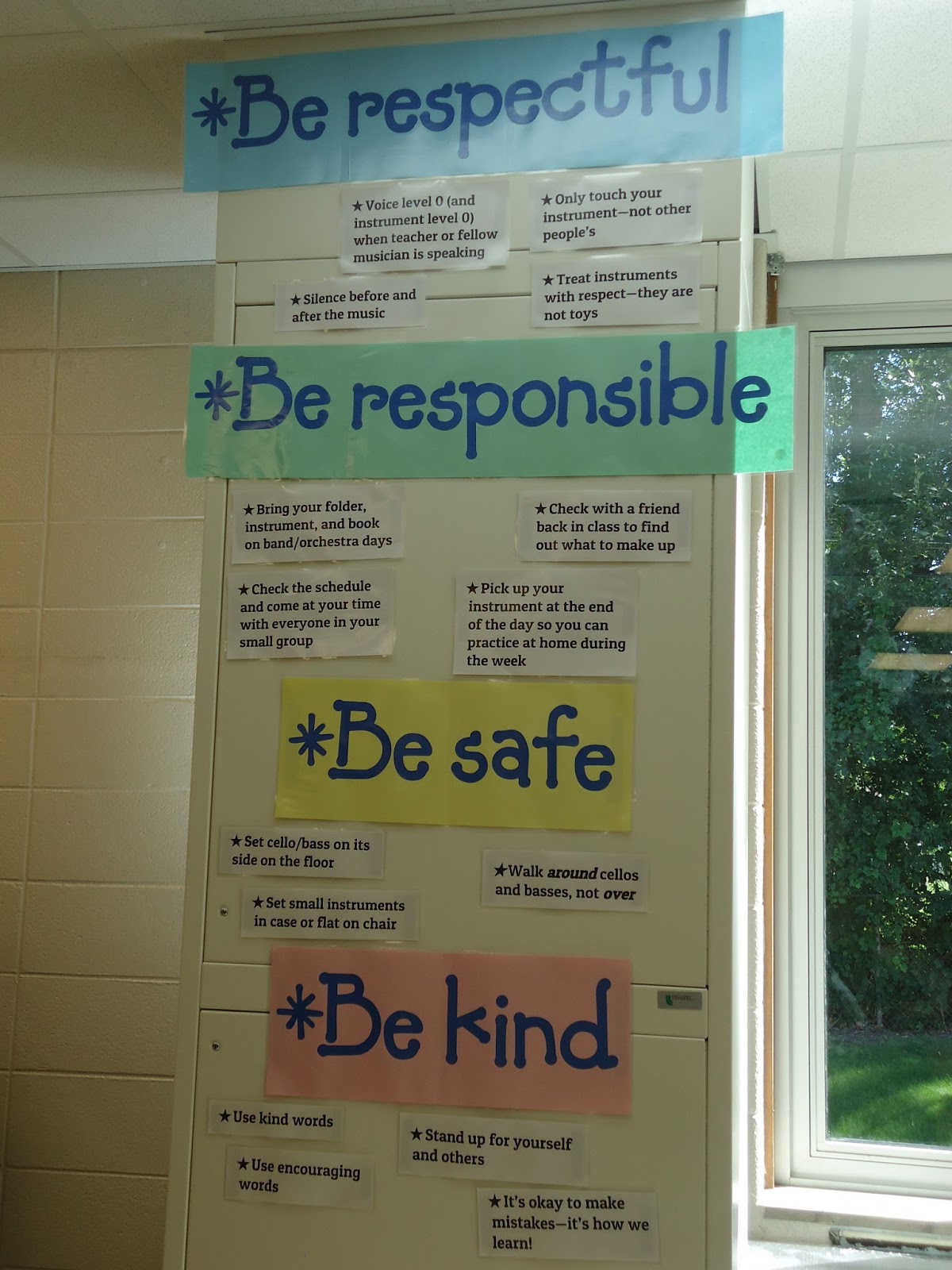
My school's four rules are:

  • Be responsible
  • Be safe
  • Be respectful
  • Be kind

Underneath each rule are examples of what this looks like in the elementary band/orchestra classroom with positive language.

Rules

Feel free to use or to make a copy of the Google doc to update for your needs!


Orchestra classroom rules

Orchestra classroom rules


Orchestra classroom rules


Wednesday, August 26, 2015

Beginning of the Year "Changes" Bulletin Board

Bulletin board changes in music

For this beginning of the year bulletin board, I wanted to highlight changes in music throughout the years and have students start thinking about how they will grow in their learning this year.  I used a different colored background for each category and linked them with black yarn:
  • history of the trumpet
  • keyboard instruments
  • recorded sound
  • violin bows 
  • me as a beginning violinist in elementary school up until more recent years
 Feel free to use!  And here are the labels along with approximate dates.

Bulletin board changes in music

Bulletin board changes in music

Bulletin board changes in music

Bulletin board changes in music

Bulletin board changes in music

Bulletin board changes in music

Tuesday, August 25, 2015

"Welcome" Bulletin Board


For the beginning of the school year, I made a welcome back bulletin board with instruments and greetings from all around the world.  With a world map and black yarn, I matched each instrument and greeting to its corresponding country.  Feel free to use!

Here's a list of the different string instruments and countries represented:

  • Balalaika, Russia
  • Celtic Harp, Ireland
  • Charango, Peru
  • Electric Guitar, U.S.A.
  • Erhu, China
  • Goje, Sudan
  • GuitarrĂ³n, Mexico
  • Hardanger Fiddle, Norway
  • Koto, Japan
  • Molo, Ghana
  • Mountain Dulcimer, U.S.A.
  • Oud, Iraq
  • Pipa, China
  • Sitar, India
  • Ukulele, Hawaii, U.S.A.
  • Violin, Italy


Welcome bulletin board world instruments


Welcome bulletin board world instruments


Welcome bulletin board world instruments


Welcome bulletin board world instruments


Welcome bulletin board world instruments


Monday, August 24, 2015

Solfege and Major Scales

Solfege and Major scale bulletin board

Here's a colorful solfege scale, complete with hand signs.  I also made squares of letter names for the different major scales introduced in beginning orchestra (D, G, and C Major) that line up to the solfege.

Using long strips of colored paper as the background, add Velcro stickers to turn these into interactive  teaching tools.  Scramble up the notes of the scale and have students arrange them in the proper order.  Or have students point to notes of their choosing for their classmates to play for a quick way to practice new notes being introduced and to explore composition and improvisation.


Solfege and Major scale bulletin board

Solfege and Major scale bulletin board

Solfege and Major scale bulletin board

Solfege and Major scale bulletin board